John,
Glyphons do have tails -- the picture tells the tale. Not a good
picture. Photo taken of image on a Greek vase. Some distortion.
Now, how do I know this is a Glyphon. Because my dear friends, Jackie
and Jan, wise in the ways of ancient things, though subject to fits
of giggling, brought me this vase from a Greek isle, and they would
not lie to me.
Here is a picture taken from the vase (slightly distorted due to curvature)
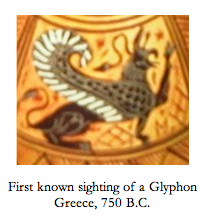
Note the wedge shaped tail: "chisel-like", no?
Logic forces us to conclude that Glyphons must have such tails, else
what would they use to inscribe letters into stone? There is no
indication that they use or need to use tools.
Yes, I knew about griffins and gryphons. I chose the word "Glyphon"
because it was the right name for the creatures, being taken from the
name of their chosen task, and because it was my intention to begin
the telling of a story, true, of course, but never before known.
It has been argued that Glyphons may be an especially visionary and
philosophical breed of Gryphons, perhaps evolved through encounters
with Sufi teachers, some of whom lived long before Islam, those who
have taken the ancient way, the primordial path of direct experience
of the Real (Wikipedia). I speculate. Such things are beyond my
knowledge. But this I do know: Gryphons, for all their ferocity, are
dull beasts in comparison to Glyphons.
"Glyph" is ancient Greek for "carving," hence suitable for written
characters inscribed in stone, and by extension recorded on paper,
and by further extension anything recorded on any medium at all.
Websters:
Glyph \Glyph\, n. (Arch[ae]ol.)A carved figure or character, incised or in relief; a carved
pictograph; hence, a pictograph representing a form
originally adopted for sculpture, whether carved or painted.
Wikipedia, from the article on "glyph":
For a given typeface or font, each character typically corresponds
to a single glyph. However, this is not always the case, especially
in a font used for a language with a large alphabet or complex
writing system, where one character may correspond to several glyphs,
or several characters to one glyph.
Generally, I use the word loosely for "an inscribed" or "written"
thing, and apply it to words, pictures, sounds, and images static and
dynamic, i.e. to the entire spectrum of digitally recorded and stored
entities. All of these digital forms will eventually be found in the
glyphery. And someday, if storage is again analog the entities will
still be "glyphs" and the collection will be a "glyphery".
The Glyphery will become as if a great wall, on which are inscribed
pictures that tell the story of the emergence of Openworld, the
visible manifestation of freeorder, a home for explorers. Each glyph
may be seen as a brushstroke, or a small image. Combined, and from a
distance, they form an astonishing mural. It seems that Glyphons are
fascinated by the evolution of this mural, and consider themselves
its guardians and messengers. Something about Glyphons makes them
intensely interested in the Promethean aspect of human beings. I
don't yet know why this is, but I am curious about it, and grateful.
Later, Peter suggested:
The Sufi connection is intriguing. Contact with the great Persian tradition
of Zoroastrianism seems quite likely to me as well. Notice the similarity
of glyphons to (legal?) eagles, the presence of an eagle as one of the two friends
of Zarathustra (a.k.a. Zoroaster) in Nietzsche's Also Sprach Zarathustra
(perhaps this eagle was really a glyphon but Nietzsche in his usual slippery fashion
masked him as an eagle), and Nietzsche's interest in revaluating the table
of values through a self-legislating beneficence of overflowing spiritual power
and insight. Is not such an attitude of nobility quite becoming to that wise creature
the glyphon? Notice also the connection between Zoroastrianism and the later
traditions of Gnosticism (from Greek gnosis or "insight"), Manicheism, and
Albigensianism -- participants in these movements were considered to be heretics
by the hierarchical Christian orthodoxy, but in fact they practiced free thought
and actively built emergent communities of insight and brotherhood. Another
connection to freeorder!Perchance an essay on the glyphon would be appropriate for the Glyphery?
And Leif said:
Peter, this is wonderful! I love these connections -- exactly the sort of
thing intuition told me would be revealed once we started thinking about Glyphons.
The essay notion is intriguing. I have thought such is needed. We must never, never
say that we have made this whole thing up, because of course, there is considerable
danger that such a statement might be false. And, yes, most of the history of the
gradual and painful emergence of freeorder has been buried by the work of those
desperate to preserve their own dominance. Archeologists are needed who will reveal
the outlines of old continents and tell us of great lost cities.
###